

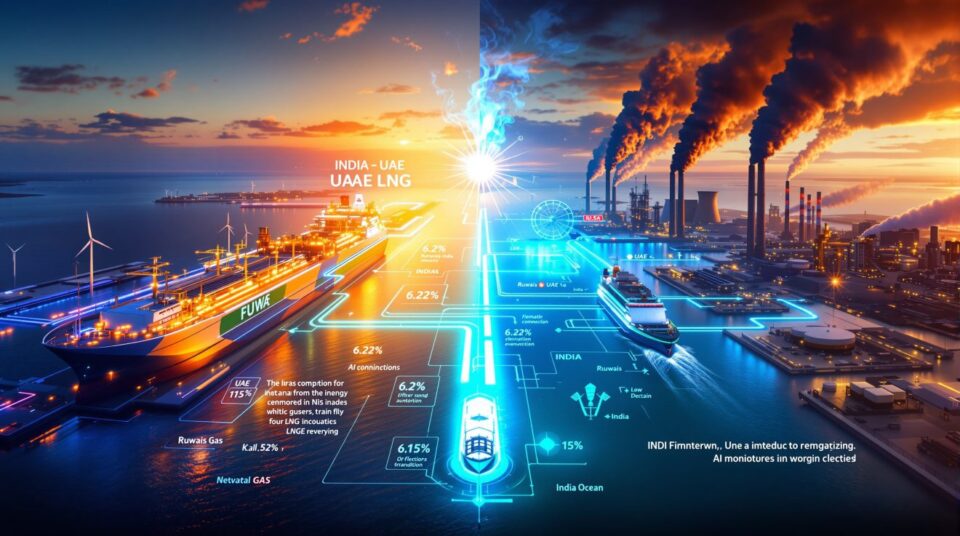
The recently signed 15-year Sales and Purchase Agreement (SPA) between Abu Dhabi National Oil Company (ADNOC) and Indian Oil Corporation (IOC) represents a landmark moment in Indo-UAE energy collaboration. Under the agreement, ADNOC will supply 1 million tonnes per annum (mtpa) of liquefied natural gas (LNG) from its Ruwais LNG project, establishing a new energy corridor that strengthens both countries’ strategic positions while reshaping traditional supply networks across the region. By 2029, IOC is expected to become ADNOC’s largest LNG customer, with total offtake reaching 2.2 mtpa, highlighting the growing importance and depth of this bilateral partnership.
The Ruwais LNG project is notable not just for its scale but also for its technological and environmental innovations. It will be the Middle East’s first LNG plant powered by clean energy, incorporating advanced artificial intelligence systems for operational optimization, clean power integration to minimize carbon emissions, state-of-the-art safety protocols, and real-time monitoring systems. These features position the UAE as a pioneer in environmentally responsible LNG production, providing a competitive edge in global markets increasingly focused on sustainability. Geographically, Ruwais offers direct maritime access to Indian ports, reduced vulnerability to shipping disruptions, diversified supply routes, and streamlined customs procedures under the CEPA framework. Proximity alone is expected to cut transportation costs by 15–20% compared to more distant suppliers, enhancing India’s energy security while guaranteeing a stable market for UAE LNG exports.
The partnership directly supports India’s energy transition goals. India aims to increase the share of natural gas in its energy mix from 6.2% today to 15% by 2030, and the ADNOC agreement provides a reliable source of cleaner-burning fuel for power generation, industrial processes, and domestic consumption. Transitioning to LNG also brings environmental benefits, including 50–60% lower carbon dioxide emissions compared to coal, reduced particulate matter and sulfur dioxide in urban areas, and progress toward meeting Paris Agreement climate targets. As such, LNG serves as a transitional fuel that allows India to balance economic growth with sustainability objectives and public health considerations.
Economically, the LNG agreement benefits from the 2022 Comprehensive Economic Partnership Agreement (CEPA) between India and the UAE, which eliminates import tariffs on LNG, streamlines regulatory procedures, and offers preferential treatment for bilateral trade. Beyond direct energy supply, the partnership encourages infrastructure development, including LNG receiving terminals along India’s coastline, expansion of distribution networks, industrial applications in petrochemicals, and knowledge transfer in energy efficiency. These downstream opportunities generate jobs and foster industrial development in both countries, extending the impact far beyond the core LNG agreement.
Strategically, the India-UAE energy axis helps diversify India’s energy sources beyond traditional suppliers like Qatar and Russia while strengthening the UAE’s position as a key energy hub connecting East and West. It provides alternatives to China-dominated energy corridors in the region and creates avenues for maritime and regional security cooperation. The partnership also aligns with broader diplomatic initiatives, supporting Middle East normalization efforts, regional energy security frameworks, and Indo-Pacific multilateral engagements, thereby enhancing resilience against shifting political or economic circumstances.
Despite its promise, the partnership faces challenges. Market volatility, including LNG price fluctuations, competition from lower-cost producers, technological disruptions from renewables, and regulatory changes, could affect contract economics. Geopolitical risks, including maritime security threats, regional political instability, great power competition, and domestic policy changes, further complicate long-term planning. Effective risk management and continuous diplomatic engagement will be essential to sustain the partnership over its 15-year term.
Looking ahead, the agreement provides a foundation for broader cooperation beyond LNG trade. Opportunities exist in joint renewable energy ventures, particularly solar, hydrogen production and transportation, carbon capture initiatives, and integrated energy infrastructure projects across multiple countries. The partnership also facilitates technology sharing, research collaboration, and capacity building for energy sector personnel, enhancing long-term human capital and technological capabilities. Globally, the pact contributes to shifting LNG trade patterns, integrating Middle Eastern and South Asian energy markets, developing new regional pricing mechanisms, and creating alternative supply routes that reduce traditional dependencies. It also offers a model for energy diplomacy that integrates commercial, strategic, and environmental goals.
Under the agreement, India will initially receive 1 mtpa of LNG from Ruwais, with total offtake reaching 2.2 mtpa by 2029 when including ADNOC’s Das Island operations. The Ruwais LNG facility is scheduled to begin commercial operations in 2028 and will be the first Middle Eastern LNG plant powered by clean energy. The partnership diversifies India’s supply sources, ensures a reliable long-term supplier, and supports the country’s transition to cleaner energy, all while operating within the CEPA framework, which eliminates tariffs and creates preferential trade terms.