

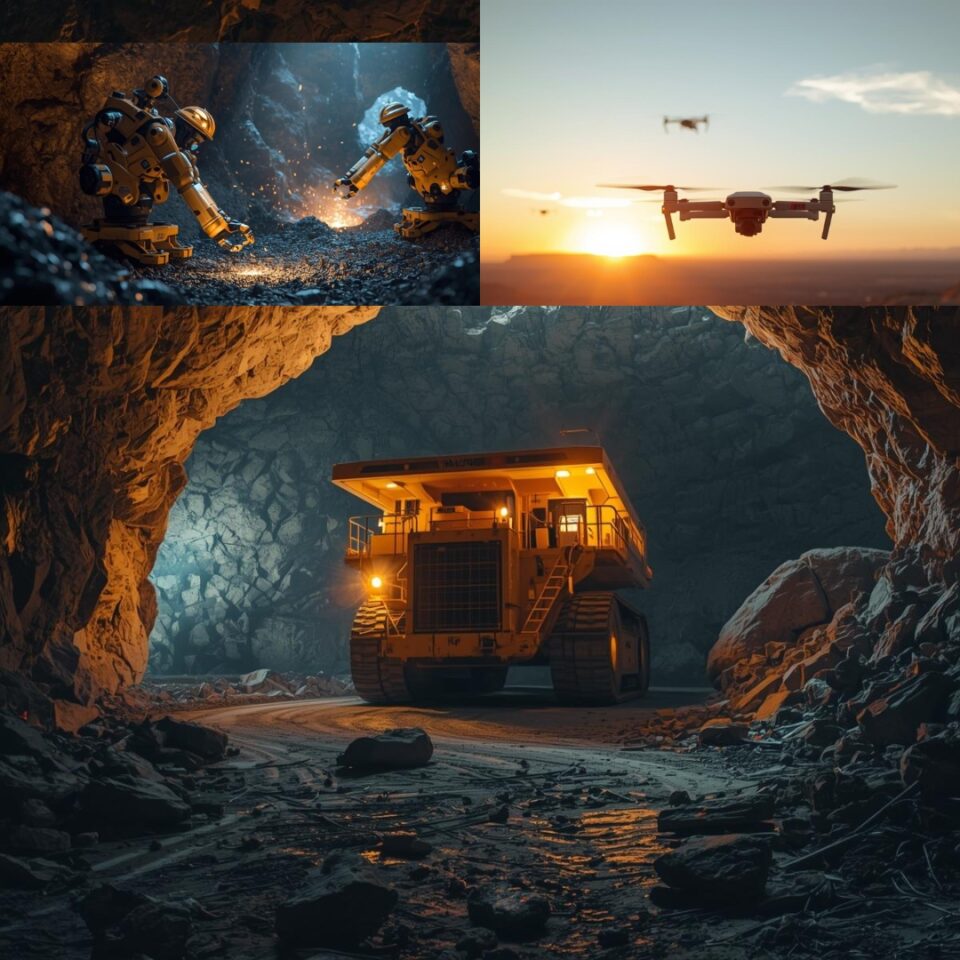
Artificial intelligence is rapidly reshaping the global mining industry, driving a fundamental shift from labour-intensive, reactive operations to highly automated, data-driven systems. Across exploration, extraction, safety, and environmental compliance, AI is no longer a future concept—it is becoming a core operational requirement for competitive and sustainable mining.


The convergence of machine learning, advanced sensors, automation, and real-time analytics is redefining how mining companies discover resources, optimise production, manage risk, and meet increasingly stringent regulatory standards.
A structural shift toward data-driven mining
Mining’s digital transformation is accelerating as companies respond to declining ore grades, rising costs, and tighter environmental regulations. Global average copper grades have halved over the past three decades, while gold grades have fallen steadily, forcing operators to process more material for the same output. AI enables precision optimisation that traditional methods cannot achieve, making lower-grade deposits economically viable.
Industry analysis shows AI and machine-learning solutions now account for nearly a fifth of total mining technology investment globally, with adoption expanding fastest in Australia, Canada, and Chile.
Six core mining domains transformed by AI
AI is now embedded across six interconnected operational areas:
- Exploration and geology: Machine learning algorithms identify subtle mineralisation patterns across massive datasets, reducing drilling requirements and accelerating discovery timelines.
- Extraction and processing: Real-time optimisation systems improve recovery rates, reduce water and energy consumption, and stabilise product quality.
- Safety and risk management: Predictive models identify hazards before incidents occur, shifting safety management from reactive to preventative.
- Environmental monitoring: Continuous sensor networks automate emissions, water quality, and compliance reporting.
- Supply chain and logistics: AI optimises transport routes, port scheduling, and inventory management.
- Maintenance and asset management: Predictive analytics forecast equipment failures days in advance, minimising unplanned downtime.
Early adopters are achieving cost advantages of 8–15% compared with conventional operations, according to industry benchmarks.
Smarter exploration and faster discoveries
AI has become a game-changer in mineral exploration. Modern exploration programmes generate tens of terabytes of geophysical and geochemical data per project—far beyond the capacity of manual interpretation. AI-assisted analysis can complete data processing in weeks instead of months, while improving target definition accuracy.
Pilot projects have demonstrated reductions of up to 30% in exploration drilling and significant improvements in discovery success rates, particularly in greenfield regions.
Optimising production and equipment performance
In active mines, AI systems monitor ore grades, flotation performance, and processing efficiency in real time. Copper concentrators using AI-driven optimisation have recorded recovery improvements of up to 7%, alongside reductions in water use and energy intensity.
Autonomous haulage and drilling systems are also gaining traction, delivering higher fleet utilisation, lower maintenance costs, and substantial safety improvements by removing workers from high-risk environments.
A new era of predictive safety management
Safety is one of the most transformative areas for AI adoption. Mining remains among the world’s most hazardous industries, but predictive analytics are changing risk management models. AI systems integrate environmental sensors, equipment telemetry, and personnel tracking to forecast hazardous conditions up to 48 hours in advance.
Operations using AI-based safety monitoring report sharp reductions in near-miss incidents, faster hazard detection, and fewer production stoppages linked to safety events.
Strengthening environmental compliance and sustainability
Environmental monitoring is becoming increasingly complex as regulators demand continuous data and detailed reporting. AI-powered monitoring systems provide near-real-time oversight of air quality, water systems, and emissions, achieving accuracy and data completeness levels unattainable through manual sampling.
Automated compliance reporting reduces administrative costs while improving transparency. AI-based sustainability platforms also support emissions accounting and Net Zero planning by integrating Scope 1, 2, and 3 emissions data across entire mining operations.
Supply chain intelligence and market forecasting
AI is also transforming mining logistics and commercial decision-making. Advanced optimisation models reduce fuel consumption, improve transport efficiency, and minimise delays at ports and processing hubs. On the commercial side, AI-driven demand and price forecasting models consistently outperform traditional methods, enabling better production scheduling and inventory management.
Technologies driving the AI mining revolution
Key enabling technologies include machine learning and deep learning, computer vision, industrial IoT sensor networks, edge computing, robotics, and digital twins. Many large mining operations now deploy thousands of connected sensors, generating terabytes of data daily, processed locally through edge computing to enable instant decision-making.
Implementation challenges remain
Despite its benefits, AI adoption is not without challenges. Legacy systems, data quality issues, cybersecurity risks, workforce skills gaps, and change management remain significant hurdles—particularly for smaller operators. Successful implementation typically requires phased deployment over several years, combined with strong organisational alignment and investment in workforce training.
The future of AI-enabled mining
Over the next decade, AI is expected to drive the transition toward increasingly autonomous mining operations. Near-term priorities focus on safety and process optimisation, while medium-term goals include fully integrated digital twins and autonomous production systems. In the longer term, AI could underpin near-fully autonomous mines with minimal human intervention.
As regulatory pressure, cost inflation, and resource depletion intensify, AI adoption is rapidly becoming a strategic necessity rather than a competitive differentiator.
A strategic imperative for the mining industry
The AI revolution in mining represents a permanent shift toward safer, more efficient, and more sustainable operations. Companies that integrate AI early and effectively are positioning themselves for long-term resilience, while those that delay risk falling behind in an increasingly data-driven industry.