

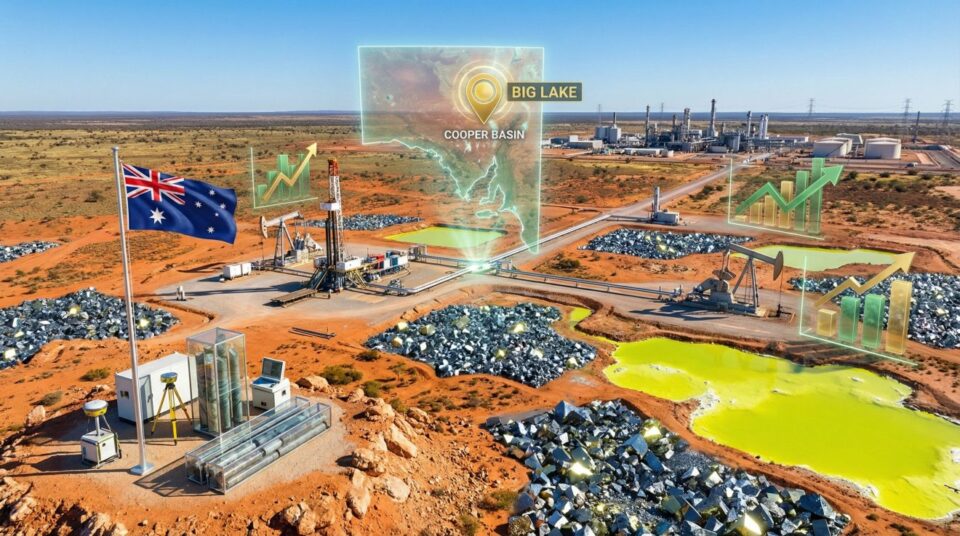
The Big Lake uranium project has delivered a significant exploration breakthrough, highlighting how advanced extraction technologies and strategic infrastructure integration are reshaping Australia’s energy and mining landscape.


Located in South Australia’s remote Lake Eyre Basin, the discovery underscores a broader shift in Australia’s resource sector, where technological innovation is unlocking uranium deposits once considered uneconomic. This comes as global demand for nuclear fuel accelerates, driven by decarbonisation targets, energy security concerns, and renewed investment in nuclear power across major economies.
Unlocking value through advanced extraction
The Big Lake project demonstrates the growing economic viability of frontier uranium exploration. Situated beneath the Cooper Basin, the project benefits from proximity to established energy infrastructure, including transport corridors, power supply, water systems, and communications networks. These advantages significantly reduce development costs and shorten potential timelines to commercial production.
Modern exploration and extraction techniques—particularly in-situ recovery (ISR)—are enabling uranium recovery from palaeochannel-hosted deposits with lower capital intensity and reduced environmental impact compared to conventional mining methods.
Geological advantages support ISR potential
Uranium mineralisation at Big Lake is hosted within the Namba Formation, a well-understood palaeochannel system characterised by permeable sandstones ideal for ISR extraction. Recent drilling intersected mineralisation at depths of approximately 90 to 130 metres, an optimal range that minimises overburden while maintaining geological stability.
Key geological advantages include high permeability for fluid circulation, predictable mineral continuity, and contained mineralised zones that reduce environmental risk. These characteristics are consistent with successful ISR uranium operations elsewhere in South Australia.
Infrastructure synergies drive project economics
The Cooper Basin’s established infrastructure offers major development synergies. Existing roads, energy supply, water access, and workforce accommodation reduce upfront capital requirements and allow developers to focus investment on extraction and processing.
Such infrastructure convergence enhances project economics and supports scalable development, positioning Big Lake as a competitive asset within Australia’s uranium sector.
Strengthening Australia’s uranium supply position
Australia is the world’s third-largest uranium producer, supplying approximately 28% of global uranium exports. Current production is concentrated at Olympic Dam, Beverley, Honeymoon, and Ranger, with the latter scheduled for closure in 2026.
New discoveries such as Big Lake are critical to maintaining Australia’s supply leadership as legacy operations mature. Global uranium demand is forecast to grow by up to 40% by 2030, driven by reactor construction in Asia, Europe, and North America, as well as life-extension programmes for existing nuclear plants.
Exploration success and development pathway
The 2024 drilling campaign at Big Lake achieved several key technical milestones, validating geological models developed over the past two years. Assay results confirmed economically significant uranium mineralisation across multiple intercepts, reinforcing the project’s development potential.
Planned next steps include expanded resource definition drilling in 2025, followed by metallurgical testing, environmental baseline studies, and commercial viability assessments through 2026 and 2027. Subject to regulatory approvals, potential development could follow later in the decade.
Community engagement and regional benefits
The project has established early engagement with Yandruwandha Yawarrawarrka Traditional Landowners, setting a foundation for responsible development that respects cultural heritage and promotes economic participation. Indigenous partnership frameworks include consultation processes, employment opportunities, and cultural heritage protection measures.
ISR uranium projects typically generate 150–200 direct jobs and several hundred indirect roles, delivering meaningful economic benefits to remote regions through employment, procurement, infrastructure investment, and tax revenues.
Favourable market conditions and investment outlook
Uranium prices have rebounded strongly, rising more than 170% from 2020 lows to around US$82 per pound in late 2024. Supply constraints, utility stockpiling, and expanding nuclear capacity continue to support long-term price strength.
ISR projects like Big Lake benefit from lower capital requirements—typically 60–70% less than conventional mining—along with shorter development timelines and reduced surface disturbance. These advantages position the project favourably amid heightened investor interest in clean energy minerals.
Strategic role in the global energy transition
As nuclear power regains prominence in global decarbonisation strategies, uranium projects in stable jurisdictions are increasingly viewed as strategic assets. Australia’s political stability, established regulatory framework, and export infrastructure make it a preferred supplier for nuclear fuel-hungry economies.
With demand projected to rise sharply through 2040, discoveries such as Big Lake reinforce Australia’s long-term role in supporting global energy security while advancing low-carbon energy systems.