

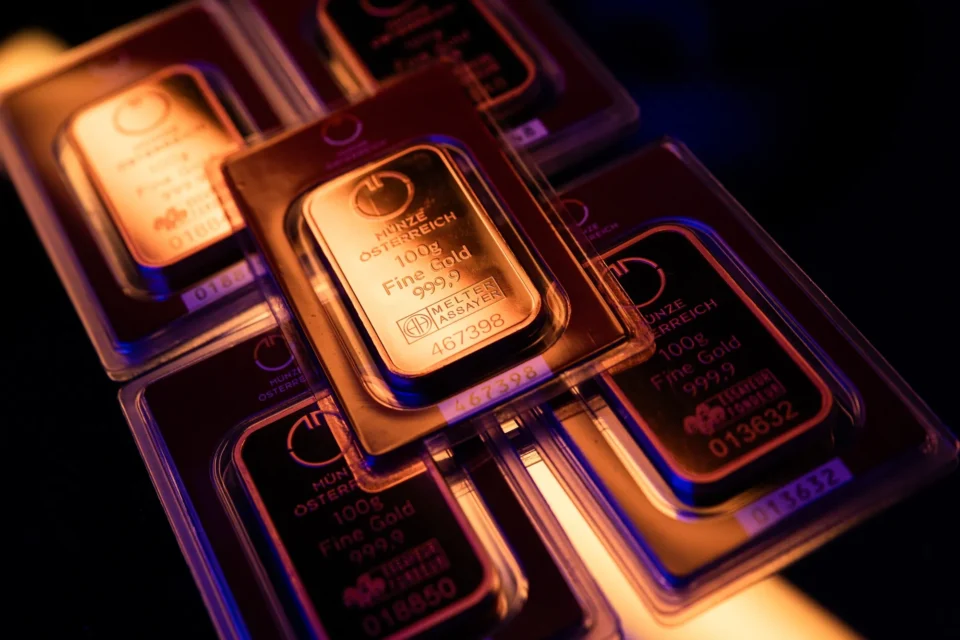
Gold prices staged a recovery after hitting their lowest level of 2026, following a decision by Donald Trump to delay potential military strikes against Iran. The move helped ease market fears of prolonged conflict in the Middle East and its inflationary impact on global markets.
Earlier in the day, spot gold had dropped sharply in London, falling by as much as 8% to around $4,100 per ounce — its lowest level this year. However, sentiment improved after Trump announced a five-day pause in military action, citing “productive” discussions with Iran. By late morning trading in New York, gold had recovered most of its losses, trading about 0.6% lower at roughly $4,480 per ounce. Futures on the Comex remained down 2.7% at $4,471 an ounce, while silver also rebounded after earlier steep declines.
The precious metal is coming off its worst weekly performance since the 1980s, following eight consecutive sessions of losses. The broader downturn has been driven by escalating geopolitical tensions and fears of rising inflation, which reduce the likelihood of interest rate cuts and strengthen the US dollar — both factors that typically weigh on gold prices.
In addition, a global liquidity squeeze has pushed investors to sell profitable assets such as gold to offset losses in equities. While gold is traditionally viewed as a safe-haven asset during periods of uncertainty, its strong rally over the past year has led some analysts to describe it as an “overcrowded trade.” Analysts at Citigroup noted that gold has recently behaved more like a risk asset during market downturns, reflecting heavy momentum-driven and retail buying in recent months.
There are also indications that central banks may be contributing to the recent price pressure. According to analysts at Natixis, some central banks could be selling gold reserves to stabilise their currencies or finance rising energy costs linked to the conflict. Although central banks have been major buyers of gold since 2022, the pace of accumulation had already begun to slow heading into 2026.
Market observers have drawn parallels between the current পরিস্থিতation and past crises, such as the aftermath of the Russian invasion of Ukraine. In those cases, gold initially surged before declining as inflationary pressures and energy price shocks spread through the global economy. Analysts at BNP Paribas point out that similar patterns were seen during previous economic shocks in 2008, 2020, and 2022, where gold prices eventually rebounded after initial declines.
Looking ahead, analysts expect continued volatility in gold markets as long as geopolitical tensions remain unresolved. However, despite short-term fluctuations, the longer-term outlook for gold remains positive, supported by its role as a hedge against economic uncertainty and inflation.