

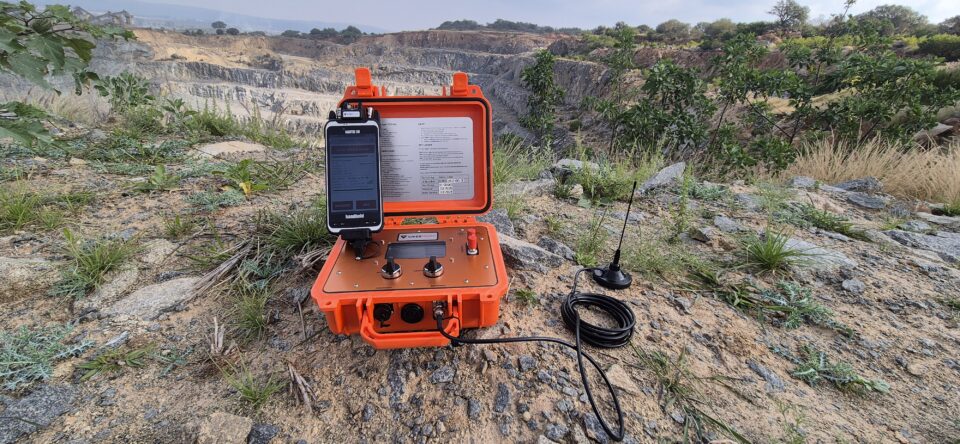
The mining sector’s gradual shift from non-electric (NONEL) to electronic initiation systems in blasting has received a welcome boost as BME releases its new VIPERTRON® Electronic Initiation System.
Ralf Hennecke, Managing Director of BME, highlighted that electronic initiation systems have consistently demonstrated superior accuracy, safety and blast performance. Nonetheless, said Hennecke their widespread adoption has been slower than many had anticipated.
“The reasons are well understood,” he explained. “Many mining operations continue to face capital constraints, skills shortages and operational pressures that make the transition to electronic initiation appear costly and complex.”
In this context, operations that already deliver acceptable results with traditional systems often perceive a risk of disruption associated with changing blasting technologies. Recognising these industry realities, BME has developed its new VIPERTRON® system to overcome the barriers that have historically discouraged mines from embracing electronic initiation, he said.
“Our intent is clear and deliberate: to make electronic initiation technology universally accessible in the mining sector,” said Hennecke. “VIPERTRON® delivers this in a manner that not only enhances safety, sustainability and economic viability, but is also operationally intuitive.”
Well-known advantages
He highlighted that the time was right for such a sea change, as the mining sector is today well aware of the limitations of traditional non-electronic systems – which continue to limit blast consistency, fragmentation and downstream productivity. The resulting variability in blast outcomes, he noted, influences everything from loading efficiency and crushing performance to energy consumption and overall mine economics.
“BME believes that electronic initiation should not be viewed as a premium solution reserved for large or highly mechanised operations,” said Hariparsad. “Rather, we are convinced that this technology should become an accessible industry standard capable of delivering measurable value across mines of all sizes,” commented Nishen Hariparsad, BME General Manager of Technology and Marketing.”
Electronic initiation systems have long been recognised for their ability to deliver significantly greater timing precision than traditional shock-tube systems, he explained. Accurate programmable delays provide far greater control over burden relief, rock movement and fragmentation.
Addressing the gap
“The challenge in the mining sector has never been proving the technical advantages of electronic initiation,” he argued. “The greater obstacle has been justifying the investment and managing the operational transition. This is precisely the gap that VIPERTRON® has been engineered to address.”
He explained that VIPERTRON® represents focused innovation aimed at delivering dependable functionality and operational value in response to mining market challenges. BME has focussed on delivering core capabilities that generate the greatest operational value while simplifying system architecture and workflows.
“While accessibility has been a major design objective, VIPERTRON® retains the technical advantages that define modern electronic initiation,” he said. “This includes exceptional timing accuracy, with a coefficient of variance of approximately 0,02%, enabling highly consistent blast execution and improved vibration control.”
Programmable delays support burden-relief-based blast design, allowing engineers to optimise rock movement and fragmentation for individual mining conditions. VIPERTRON® also incorporates comprehensive diagnostics and system integrity testing before blasting, significantly reducing the likelihood of misfires while improving confidence in blast execution. Its dual communication channels and high immunity characteristics further enhance operational safety in demanding mining environments.
“The result is an electronic initiation solution designed to lower adoption barriers without compromising performance,” said Hariparsad.
Historically, affordability has remained one of the biggest obstacles deterring wider implementation of electronic initiation systems. VIPERTRON® has therefore been developed with cost competitiveness firmly in mind, he said.
“By optimising system design and focusing on the functionality that matters most to mining operations, BME aims to enable mines to transition to electronic initiation without introducing a significant step change in operational costs,” he said.
Bridge to improvement
Hariparsad emphasised that VIPERTRON® is purpose built as a bridge technology for operations which are experienced in shock tube and traditional systems. The system therefore provides intuitive bench practice and operational workflows aligned to existing NONEL operational practices.
“Many mines hesitate to introduce new technologies because of concerns around retraining of personnel, disrupting established blasting practices or introducing unnecessary operational complexity,” he said. “VIPERTRON® has been specifically designed as a practical bridge, so operations can adopt electronic initiation through intuitive workflows, straightforward system logic and minimal additional training requirements.”
This allows mines the opportunity to upgrade their initiation technology and transition to an advanced electronic initiation system without destabilising their operation – so that they can preserve their productivity while improving blasting outcomes.
“This launch supports the mining sector’s commercial objectives alongside industry‑wide improvement – aligning with the Omnia vision of innovating to enhance life, and together creating a greener future,” concluded Hariparsad. “As a technology partner in mining, BME is committed to making electronic initiation the industry norm, not the privilege of the few.”

