

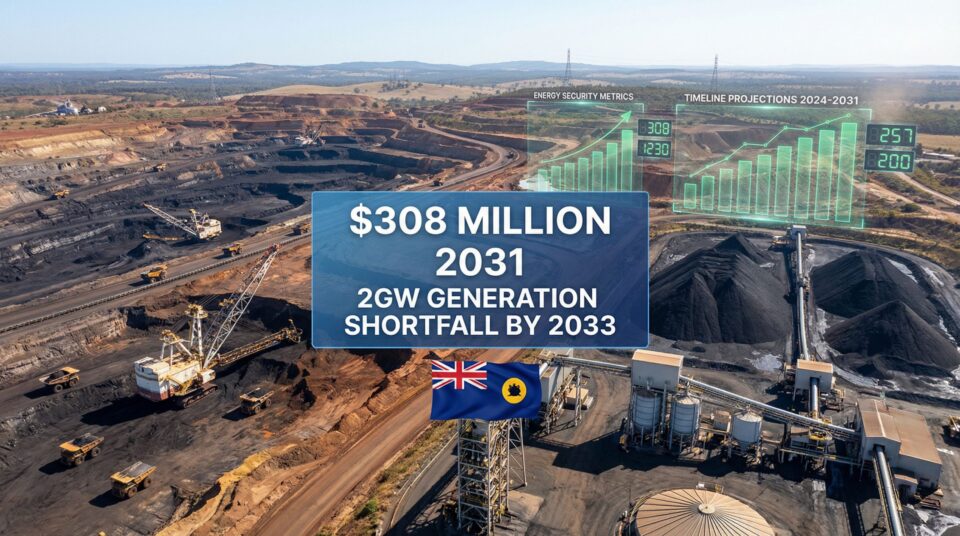
The Western Australian government has confirmed a strategic extension for Griffin Coal operations, ensuring continued production through 2031 despite financial and market challenges. This intervention highlights the complex balancing act faced by resource-dependent economies navigating the global energy transition. Governments must weigh immediate economic and employment concerns against long-term sustainability goals, including environmental commitments and grid stability.
Government Support During Industrial Transitions
Griffin Coal has accumulated A$1.4 billion in debt since entering receivership in 2021. To maintain production capacity and support regional employment, the state committed A$308 million from 2022 through 2026. This support secures the Ewington mine’s 2.9 million tonnes annual output while allowing time for operational restructuring and customer contract renegotiation. The extension through 2031 provides operational certainty and demonstrates how government intervention can bridge temporary market failures without resorting to indefinite subsidisation.
Key aspects of the restructuring include:
- Negotiating improved commercial terms with major customers to reduce reliance on state support.
- Maintaining production capacity under receivership to ensure energy supply stability.
- Extending state agreements to provide operational certainty through 2031.
- Gradually reducing subsidies while transitioning toward partial support mechanisms.
Energy Security and Renewable Integration
Coal-fired generation remains critical to Western Australia’s grid stability, contributing roughly 15% of the South West Interconnected System’s capacity. Premature closure of coal operations could create supply vulnerabilities, especially as renewable infrastructure—including large-scale wind, solar, and battery storage—continues under development. The government frames coal as a temporary infrastructure measure that supports the renewable buildout while planning the retirement of state-owned coal facilities by 2030, including the Collie and Muja generators.
Renewable integration challenges include the completion of transmission infrastructure, deployment of battery storage, weather-dependent generation reliability, and industrial customer adaptation to alternative energy sources. Griffin Coal’s continued operation provides a critical buffer during this transition, ensuring energy security while renewable capacity scales up.
Basin-Wide Consolidation and Operational Efficiency
The Collie Basin currently hosts two coal operations: Griffin Coal and Premier Coal. With declining reserves and market pressures, the government has established a taskforce to explore potential consolidation, evaluating whether a single-entity operation would improve efficiency and resource utilisation. Consolidation could bring benefits such as shared processing facilities, streamlined logistics, unified workforce management, and enhanced customer negotiation leverage, though feasibility depends on Premier Coal’s willingness to participate.
Community and Economic Considerations
Coal-dependent communities face significant economic vulnerability during energy transitions. The Griffin Coal extension preserves jobs and provides workforce stability in the Collie region, while allowing time for skills retraining and regional economic diversification. Direct employment, supply chain impacts, and regional service industries benefit from continued mining operations, creating a smoother transition path for affected communities.
Investor and Market Implications
Government intervention provides temporary stability but introduces questions regarding long-term commercial viability. Investors must assess policy risk, customer contract volatility, and stranded asset exposure, particularly as renewable energy adoption accelerates. Companies can adapt by pursuing short-to-medium-term contracts aligned with transition timelines, operational flexibility, diversification into related services, and partnerships with renewable developers for land-use transitions.
Technology and Infrastructure Integration
The successful energy transition relies on coordinated deployment of renewable generation, battery storage, and transmission infrastructure. Coal operations continue to provide baseload reliability, mitigating risks from renewable project delays. Key technology deployment risks include project completion delays, cost and performance uncertainties of battery storage, and regulatory approvals for transmission infrastructure. Properly timed interventions ensure that coal operations act as a bridge to a sustainable renewable future rather than a permanent dependency.
Regulatory and Policy Frameworks
The Western Australian approach demonstrates regulatory flexibility, balancing environmental commitments with economic and community needs. Policy tools such as state agreement extensions, subsidy reduction pathways, and basin consolidation assessments allow for managed transitions. Success is measured by maintaining grid stability, preserving employment, achieving subsidy reduction targets, and adhering to environmental timelines.
Forward-Looking Insights
The Griffin Coal extension offers a case study in managing industrial transitions, showing how coordinated government intervention, community support, commercial restructuring, and technological planning can mitigate the risks of energy transformation. Other jurisdictions can draw lessons on early identification of critical infrastructure dependencies, stakeholder consultation, workforce transition strategies, and alignment of commercial improvements with public support.