

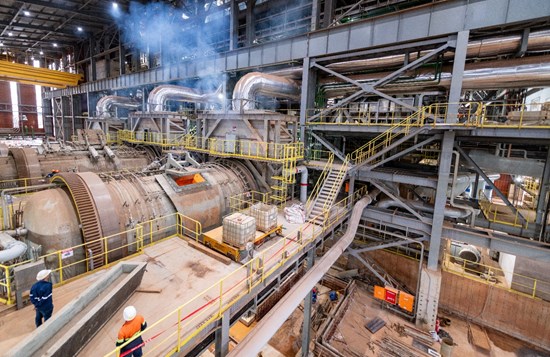
Ivanhoe Mines has successfully produced its first copper anodes at the Kamoa-Kakula direct-to-blister copper smelter in the Democratic Republic of the Congo, marking a major milestone in the development of one of the world’s largest and fastest-growing copper operations.
The first copper anode was produced on 29 December 2025, approximately five weeks after the smelter’s heat-up phase began and just one week after concentrate was first introduced into the facility. Once fully ramped up, the smelter is expected to achieve an overall copper recovery rate of 98.5% and produce up to 500,000 tonnes of copper anode per year, making it the largest copper smelter in Africa.
Ivanhoe Mines founder and executive co-chairman Robert Friedland described the achievement as transformational for the Kamoa-Kakula complex. He said the smelter will deliver high-quality Congolese copper anodes to international markets while setting new global benchmarks for scale, efficiency and sustainability in copper smelting.
Market analysts welcomed the announcement, noting that first anode production aligns with Ivanhoe’s project guidance and expectations. Following the news, Ivanhoe Mines’ share price rose by as much as 5% before easing later in the trading session. By midday in Toronto, the company was trading at approximately C$16 per share, giving it a market capitalisation of about C$23.2 billion.
Smelter ramp-up underway
Ivanhoe confirmed that ramp-up activities are continuing, with the smelter expected to reach its steady-state capacity of 500,000 tonnes per annum of 99.7%-pure copper anode by the end of 2026.
For 2026, Kamoa-Kakula’s copper production is forecast at between 380,000 and 420,000 tonnes, with the midpoint of 400,000 tonnes representing roughly 80% utilisation of the smelter’s capacity. Management intends to prioritise the processing of concentrate from the Phase 1, 2 and 3 concentrators through the on-site smelter, while any surplus concentrate will be toll-treated at the Lualaba smelter near Kolwezi.
Before concentrate feeding commenced, the site held approximately 37,000 tonnes of copper in concentrate inventory. As the smelter ramps up, total unsold copper in concentrate—held in stockpiles and within the smelting circuit—is expected to decline to about 17,000 tonnes during 2026.
As a result, Ivanhoe expects copper sales in 2026 to exceed production by approximately 20,000 tonnes, largely due to the destocking of on-site concentrate inventories during the first half of the year. The company plans to take advantage of near-record copper prices as this destocking process unfolds.
Dewatering progress at Kakula mine
Ivanhoe also reported significant progress at the Kakula underground mine following flooding caused by an earthquake in May 2025. Stage 2 dewatering has now been completed, allowing selective mining to resume in the affected eastern sections of the mine in late December—earlier than initially scheduled.
The project has now moved into Stage 3 dewatering, which involves recommissioning water-damaged underground horizontal pump stations used for steady-state operations. These activities are expected to continue into the second quarter of 2026 but are not considered critical to ongoing mining operations.
With smelter commissioning advancing and underground mining steadily recovering, Ivanhoe Mines says Kamoa-Kakula remains firmly positioned as a cornerstone copper operation in the global energy transition.