

Mining in Cornwall is enjoying a resurgence with increased investment and activity. From pilot and demonstration plants to early commercial-scale lithium production and reopening of a tin mine, these are exciting times for mining in the far southwest of England.
Whether transferring corrosive and abrasive slurries, handling high-density products or precise chemical dosing, Watson-Marlow provides a wide range of peristaltic pumps and hoses to mining projects in Cornwall.
Earlier this year, Geothermal Engineering Ltd (GEL) started commercial scale production of zero-carbon lithium carbonate from its geothermal power plant at United Downs. GEL has the capacity to produce 100 tonnes per annum (tpa) and aims to scale up to over 10,000 tpa over the next decade.
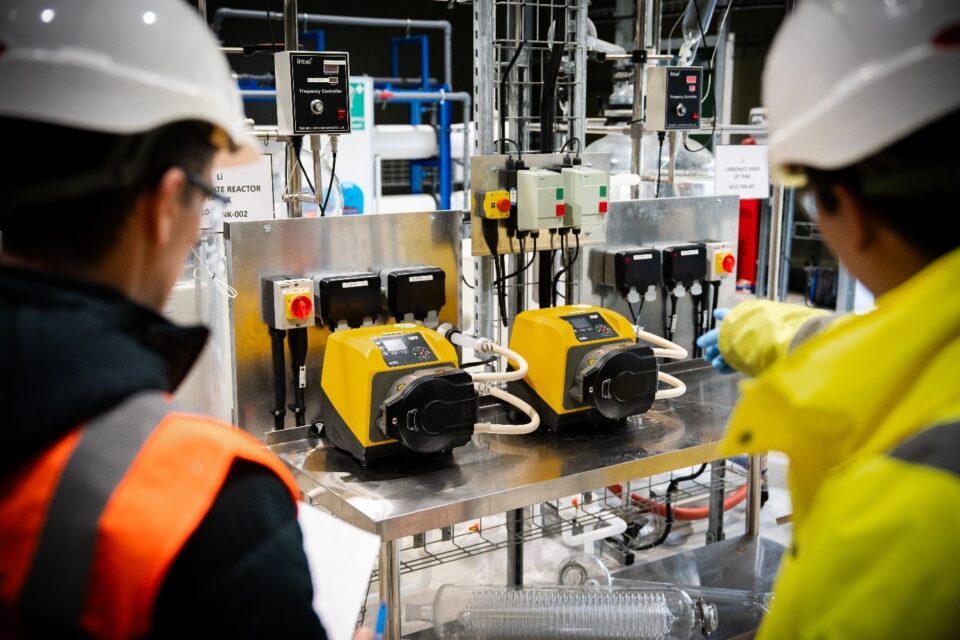
GEL relies on Watson-Marlow 630 and Qdos® peristaltic pumps to deliver the precision dosing, reliability and operator safety required for its mineral extraction process.
Two Qdos 60 chemical metering pumps are dosing acid and alkali in the removal of impurities. One doses sodium hydroxide to raise the pH level to 11 to remove impurities such as zinc, iron, silicon, and phosphorous; after the impurities have been filtered out, the other Qdos pump doses hydrochloric acid for pH correction. Accurate acid and alkali dosing is critical as poor pH control can lead to inconsistent impurity removal, excess reagent use and avoidable lithium losses.
Later in the process, three Watson-Marlow 630 pumps are used to transfer lithium brine and extract the lithium precipitate, as well as other transfer tasks. The pumps’ reliability supports uptime, maintains operator confidence and ensures safer chemical containment.
Charlotte Wilkins, Lithium and Projects Manager at GEL, said: “Dosing sodium carbonate accurately is important for us because sodium carbonate is added in a calculated quantity to ensure that all of the lithium chloride reacts to form lithium carbonate, our product. Overdosing would mean that we wasted expensive reagents. Underdosing means that we would leave lithium behind.”
Elsewhere in Cornwall, Cornish Lithium switched to flexible Corroline+ hoses for transferring a mica slurry treated with sulphuric acid after experiencing blockages caused by rigid pipework with 90-degree bends at its hard-rock lithium mining demonstration.
At the Trelavour Lithium Project, the first stage of processing to produce lithium hydroxide monohydrate involves crushing, milling and refining granite ore from a former china clay pit to produce a lithium‑rich mica concentrate slurry. This is followed by hydrometallurgical processing, where the mica concentrate undergoes acid leaching using sulphuric acid. Fifteen Corroline+ hoses, from Aflex Hose, a Watson-Marlow company, play a critical role in this stage, transferring acid slurries to drive the leaching reaction, as well as supporting downstream processes including impurity removal and by product recovery. The hose’s smooth bore ensures uninterrupted flow of mica concentrate slurry in a cascade between process tanks.
Dai Moseley, senior process manager for hard rock minerals at Cornish Lithium, said: “The hoses give us a more direct route than the rigid pipework, so it works better for us. When there’s a block, the Corroline+ hoses are easy to take apart and clean out. It’s a highly concentrated sulphuric acid at temperatures above 90°C to leach out all the metals from the mica and turn them into metal sulphates. It’s hot, acidic and abrasive so the conditions couldn’t be harsher for the hoses but we haven’t had an Aflex hose fail on us. They are the worst conditions in the plant, but the hoses handle it.”
Another mining project in Cornwall making progress towards commercial production is at South Crofty, Britain’s last tin mine to close in 1998. The price of tin has risen nearly 45% this year and Cornish Metals hopes South Crofty can restart production in 2028 to become the first primary tin producer in Europe. To get South Crofty ready for production again, Cornish Metals is decontaminating mine water from the flooded mine at a water treatment plant (WTP) before discharging it into a river.
Three Qdos 120 pumps are accurately dosing hydrogen peroxide, to oxidise the metals and cause iron and arsenic to precipitate out of the solution, in the first of five process steps at the WTP. The Qdos pumps provide containment of the chemical and reliable operation. Eight Bredel 40 hose pumps provide reliable, low maintenance and contained transfer of thick and varied sludge (containing contaminants such as iron, manganese and arsenic) which is separated from the treated water in stages two and four.
Bredel hose pumps are also being used at large-scale mine operations around the world, such as at Boliden’s Garpenberg mine (zinc, lead, silver, copper, and gold) in Sweden. The robust design of Bredel ensures reliable, low-maintenance performance in stable, high-pressure transfer of slurry and careful handling of polymer, helping Boliden maximise productivity while reducing downtime at its concentrator, tailings facility, and paste plant.
Lars Varnbueler, a Senior Global Business Lead at Watson‑Marlow, will be one of the speakers at the UK Mining Conference in Cornwall (June 10-11) and will discuss how solutions from Watson-Marlow are being used by Cornish Metals to remediate contaminated mine water.
About Watson-Marlow Fluid Technology Solutions
Watson-Marlow Fluid Technology Solutions (WMFTS) is a world leader in manufacturing peristaltic pumps and associated fluid path technologies for process industries and the life sciences.
Our peristaltic pumps, tubing and hoses excel in a wide range of challenging applications from versatile and accurate chemical dosing, to handling abrasive sludge and slurries.
Bredel hose pumps can outperform centrifugal pumps in continuous flow rates up to 72 m³/h and intermittent flow rates up to 108 m³/h when pumping concentrate, gangue or tailings, as well as chemical reagents and coagulants.
Watson-Marlow cased pumps and Qdos® chemical metering pumps offer repeatable, quick, simple and safer maintenance, which is ideal for contained dosing of reagents.
Lined with polytetrafluorethylene (PTFE), Aflex hoses offer excellent chemical resistance for transferring acids.
WMFTS is a wholly owned subsidiary of Spirax Group, with operating units worldwide.
Further information can be found at www.wmfts.com/en/mining/.
Estimated reading time: 5 minutes