

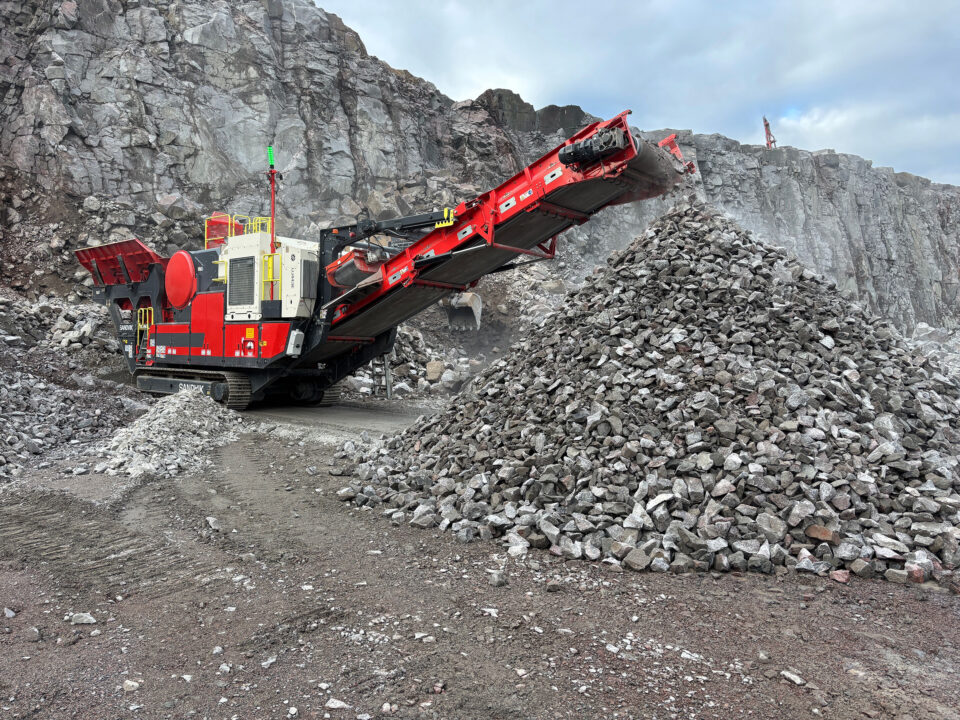
Electra Mining Africa underscored a significant shift in the priorities of mining and quarrying operations. As producers face mounting pressure to increase productivity while reducing energy consumption, operating costs and environmental impact, attention is increasingly turning towards optimising entire processing circuits rather than focusing on the performance of individual pieces of equipment.
According to Tarynn Yatras, Vice-President Sales Area Africa for Sandvik Rock Processing, discussions with customers throughout the exhibition consistently reinforced the growing importance of adopting a process-wide approach to improving plant performance.
“Across both mining and quarrying, customers are looking beyond individual machines,” Yatras explains. “Interactions at Electra Mining Africa confirmed that operators increasingly want partners who understand the complete process and can help optimise the entire crushing and screening circuit. The greatest opportunities now lie in improving how the whole system performs rather than simply replacing individual pieces of equipment.”
This marks a significant evolution in how optimisation is approached. Historically, improvements focused on individual assets, with crushers configured to maximise throughput, screens adjusted to improve separation efficiency and downstream equipment optimised independently. While these initiatives delivered benefits, they often overlooked the highly interconnected nature of modern processing plants.
“In reality, every stage of the process influences the next,” Yatras says. “A change to crushing performance affects screening efficiency, downstream classification, grinding performance, recovery and ultimately overall plant productivity. True optimisation requires understanding these interactions and designing the process accordingly.”
The increasing complexity of ore bodies, ongoing pressure to maximise existing infrastructure and tighter capital budgets have made this systems-based approach more important than ever.
Supporting this shift is Sandvik Rock Processing’s Engineering-to-Order (ETO) philosophy which recognises that no two operations are identical. Rather than offering standardised solutions, the company works closely with customers to engineer processing solutions around their specific orebody characteristics, production targets and operational requirements.
Yatras explains that Engineering-to-Order reflects a fundamentally customer-centric approach to process optimisation.
“Every operation presents its own combination of ore characteristics, production targets, site constraints and operating conditions,” she says. “Engineering-to-Order allows us to develop solutions specifically around each customer’s process rather than expecting customers to adapt their process to standard equipment.”
She says this philosophy is becoming increasingly important as mines seek to improve productivity without necessarily investing in entirely new plants.
“Much of today’s opportunity lies in helping customers unlock more value from existing assets through better process design, improved equipment integration and continuous optimisation. That requires close collaboration with customers and a detailed understanding of how their complete operation functions.”
This collaborative engineering approach is supported by Sandvik Rock Processing’s broad portfolio of stationary and mobile jaw, cone and impact crushers, vibrating screens, feeders, scalpers, rock breakers and digital process technologies. However, Yatras stresses that equipment is only one component of the overall solution.
“Our role begins long before equipment selection,” she says. “It starts with understanding the customer’s application, production objectives and operational challenges so that we can engineer the most effective processing solution. Equipment is simply the platform that enables that solution.”
One of the clearest examples of system-level optimisation can be found in comminution. Grinding remains one of the largest consumers of energy within mineral processing. By improving crushing efficiency, optimising screening performance and delivering a more consistent feed to downstream grinding circuits, operators can significantly reduce energy demand while improving throughput, plant stability and overall operating efficiency.
“Every millimetre of size reduction achieved efficiently during crushing reduces the amount of work required later in the process, where energy consumption is significantly higher,” Yatras explains. “That benefits both operating costs and sustainability.”
Digital technologies are further accelerating this transition. Advanced process monitoring, equipment automation and real-time performance data now enable operators to identify developing bottlenecks before they impact production. Rather than reacting to process disturbances, plants can increasingly maintain stable operating conditions through continuous monitoring and optimisation.
“The objective is predictable, consistent performance,” Yatras says. “Greater visibility across the processing circuit enables operators to make informed decisions that improve throughput, extend equipment life and reduce unnecessary energy consumption.”
Yatras believes this combination of engineering expertise, digital technologies, equipment tailored to customer processing requirements and long-term customer collaboration is redefining what process optimisation means for the industry.
“The strong interest shown at Electra Mining Africa reinforced that customers increasingly value technical partners who understand the complete processing ecosystem,” she says. “As operations become more complex and sustainability expectations continue to rise, process optimisation will increasingly depend on integrating engineering expertise, equipment, automation and customer knowledge into one continuous improvement journey.”
Yatras concludes that the future of rock processing will not be defined by individual machines, but by how effectively complete processing systems are engineered, integrated and continuously refined.
“Performance is no longer measured by what one crusher or one screen can achieve,” she says. “It is measured by how efficiently the entire process works together. That systems approach is ultimately what will deliver the next generation of productivity, sustainability and operational resilience.”