











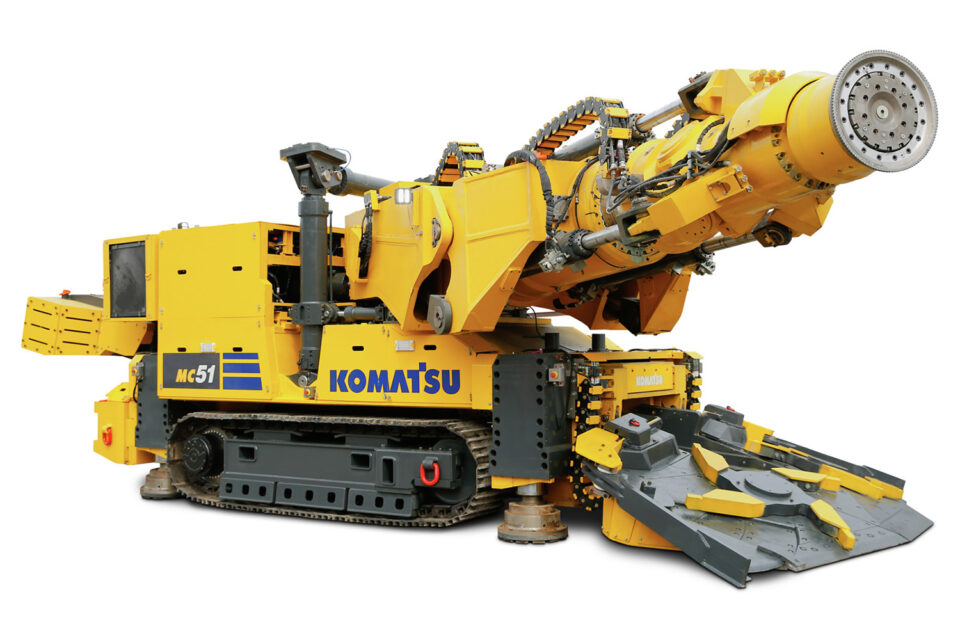
Komatsu is advancing a full-scale proof of concept for its MC51 hard-rock continuous miner at Niobec’s underground mining operation in Quebec, Canada, in partnership with Niobec, a Magris Performance Materials company, and mining contractor Cementation Americas.


The project marks a significant step towards transitioning from conventional drill-and-blast methods to mechanical cutting technologies designed to improve safety, efficiency and sustainability in underground mine development.
Located in Saint-Honoré in Quebec’s Saguenay region, Niobec is one of a limited number of niobium producers worldwide. The operation supplies a critical material used in high-strength steel and advanced industrial applications. Its experience in underground mining and medium-hard rock conditions makes it a suitable site for testing alternative development methods.
The Komatsu MC51 uses DynaCut mechanical cutting technology to enable continuous excavation, producing consistent rock sizes and precise tunnel profiles within a 5 m by 5 m heading. Unlike traditional drill-and-blast operations, the system is designed to support continuous mining while reducing reliance on explosives.
The fully electric machine also offers environmental and operational benefits. By eliminating diesel use at the machine and reducing ventilation requirements, the MC51 has the potential to lower emissions and improve underground working conditions. Its remote-operation capability further supports operator safety.
With a power requirement of 340 kW, the system is designed to integrate into many existing mining operations without requiring major upgrades to electrical infrastructure, potentially making the technology more accessible to underground mines seeking lower-emission development solutions.
The current project aims to demonstrate the MC51’s ability to operate continuously under real-world underground conditions. The initial phase involves an exploration drift of approximately 500 m, with the possibility of extending development to several kilometres if the trial meets its objectives.
Progress has continued despite technical challenges associated with early-stage deployment. In May, the project achieved an advance of 66 m, bringing total development to 357 m. Although performance has remained below planned targets at times because of technical interruptions, the trial is generating insights into machine reliability, workforce readiness and operational optimisation.
Sustained advance rates and cost efficiency remain central to the project’s commercial prospects. An initial benchmark of approximately five metres per day was established, with higher rates potentially improving the technology’s viability. The MC51 has recently exceeded this daily target, strengthening the case for mechanical cutting in comparable geological environments.
Beyond productivity, continuous mechanical mining could deliver wider safety and operational benefits. Reducing or eliminating explosives from the development cycle may help lower safety risks, simplify operations and minimise overbreak. These improvements could also support better ground conditions and reduce the need for ground support.
As the trial progresses, Komatsu, Cementation Americas and Niobec will continue working together to refine performance and address emerging challenges. Regular operational coordination will remain important to achieving the project’s objectives while maintaining rigorous safety and operational standards.
With global demand for critical minerals such as niobium continuing to grow, the results of the Canadian trial could provide valuable insights into the role of mechanical cutting in the future of underground mine development.